Within the "Hadith Al-Iqtisad" (Economic Talk) Program, the Federation Chairman Reviews the Reality of the Insurance Industry in Palestine
Palestinian Federation of Insurance Companies Chairman Anwar Al-Shanti Reviews the Reality of the Insurance Industry in Palestine
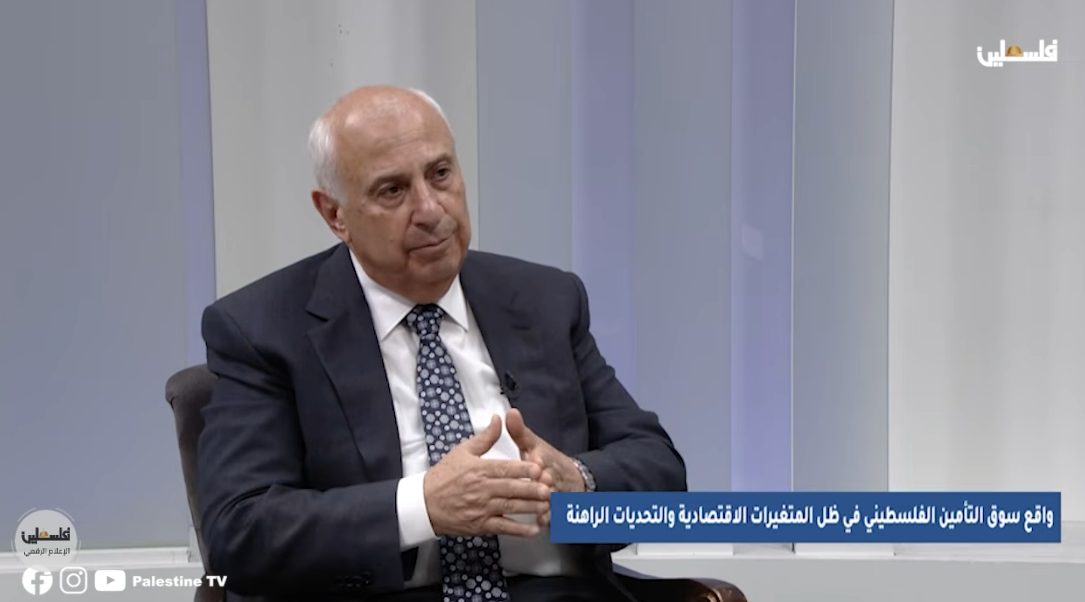
The Chairman of the Palestinian Federation of Insurance Companies, Anwar Al-Shanti, reviewed the reality of the insurance industry in Palestine during the "Hadith Al-Iqtisad" (Economic Talk) program broadcast on Palestine TV.
"Financial Data Reflects a Critical Reality"
Al-Shanti explained that the financial data of insurance companies up to December 31, 2025, reflects a critical financial situation. Outstanding premiums (receivables) owed to insurance companies by policyholders—both individuals and sectors—reached $185 million. Additionally, companies hold deferred checks worth $170 million. This brings the total of receivables and deferred checks to $355 million, which is equivalent to three times the combined capital of all Palestinian insurance companies.
He added:
"Due to the liquidity shortage, companies were forced to borrow and draw bank facilities exceeding $30 million (equivalent to 23% of their capital) to fulfill obligations and prevent damage to civil peace."
"Insurance Companies Fulfill Their Obligations"
Al-Shanti emphasized that despite this challenging reality, insurance companies continue to honor their commitments toward policyholders. In 2025, they paid out $280 million in cash to affected individuals, medical sectors, and repair and maintenance facilities.
He underscored the vital role of the insurance sector in creating a secure environment for both individuals and investors alike, noting that insurance serves as the actual engine that provides peace of mind and fosters a supportive environment for production within Palestinian society.
Impacts of the Aggression
Al-Shanti pointed out that the ultimate loser in the aggression on the Gaza Strip is the Palestinian citizen, who has sacrificed everything they own as a result of the brutal assault. He noted that the aggression has been ongoing for 80 years with the aim of emptying the land and seizing it by the occupation, which explains the ongoing strangulation and restriction of production and growth factors within the Palestinian community.
He indicated that insurance contracts do not automatically cover war risks and political turmoil. Nevertheless, some major companies and institutions held "political risk" endorsements. Consequently, Palestinian insurance companies will bear direct damages resulting from the war estimated between $30 million and $40 million.
Regarding settler attacks on citizens' vehicles, Al-Shanti stressed the necessity of protecting citizens' rights and property. However, he noted that having insurance companies directly bear the results of settler attacks carries high political and legal risks.
Instead, Al-Shanti proposed that protecting citizens' rights and property must be handled through a comprehensive national mechanism led by the Palestinian Government, the Ministry of Finance, civil society organizations, and the private sector (including insurance companies) to remedy the damages inflicted on citizens. He suggested the possibility of deducting a percentage of the fees from the Palestinian Road Accident Victims Compensation Fund to support these cases under the supervision of the Palestinian Government and the Ministry of Finance. This would support citizens' resilience while mitigating the risks and potential legalization (legitimation) of covering settler attacks.
Legislative and Policy Challenges
Al-Shanti affirmed his respect for the Palestinian judiciary and its role in safeguarding justice and rights. However, he explained that the judicial system's reliance on "eyewitness testimony" to prove the income of accident victims—without requiring official tax records—has inflated compensation values, causing a severe drain on the resources of Palestinian companies. He noted that judicial rulings issued against insurance companies following the end of the judicial recess reached 95 million shekels.
Al-Shanti called for an urgent meeting to discuss these matters and examine the legal loopholes that cause significant damage to the national economic structure in general, and the insurance sector in particular, in a way that protects citizens' rights and achieves justice for all parties.
Furthermore, he addressed the issue of medical committees, emphasizing the need for their governance to regulate disability percentage reports based on the principle of indemnification (remedying actual damage) rather than serving as a means for profiteering and illicit enrichment.
Supporting Electronic Payment
Al-Shanti pointed out that insurance prices are fixed by a Council of Ministers decree issued 18 years ago. They have remained unchanged since 2008 despite the doubling of compensation costs driven by high inflation and rising price indexes.
He clarified that the Federation's Board of Directors' decision to adhere to the tariff approved by the Council of Ministers and the payment mechanisms specified by the Capital Market Authority did not alter prices. Instead, it put an end to negative competition among companies, which had previously reached up to 20% given out as legally unauthorized discounts.
Al-Shanti added that the Federation has introduced solutions to make it easier for citizens to obtain insurance policies. These include:
- Paying 50% of the compulsory insurance in cash, and post-dating the remaining balance alongside the comprehensive insurance over 6 monthly installments via bank checks.
- Signing an agreement with the Association of Banks to grant concessionary loans over 12 months to pay for insurance, with insurance companies fully absorbing the 5% interest rate on behalf of the citizen.
- Granting a 10% discount for electronic payments, which also helps alleviate the crisis of the surplus shekel accumulation.
Repercussions of the Regional Crisis
Al-Shanti confirmed that international reinsurance companies suspended the marine "war risk cover" clause immediately following the outbreak of turmoil in the region. This forced cargo vessels to take longer, more expensive detour routes, which drove up ocean freight charges. This was directly reflected in a 10% to 20% increase in the prices of commodities and imports (such as vehicles) in the Palestinian market, in addition to reinsurers raising coverage prices for local companies.
Insurance is a Resilient Sector
Al-Shanti asserted that despite the accumulated crises since the COVID-19 pandemic, passing through currency exchange differences, and the ongoing aggression, the Palestinian insurance sector—including its directors, shareholders, and employees—is determined to remain resilient and will not evade its responsibilities.
He highlighted that the insurance market has licensed two new public shareholding companies during these crisis years (Al-Baraka Insurance and Holy Land Insurance), driven by a belief in the necessity of moving forward with construction and development within Palestinian society.
He concluded:
"Awareness of the importance of insurance exists among Palestinian citizens, and the insurance penetration rate is better than some countries in the region, despite the levels of unemployment and the financial and economic blockade."
حديث الاقتصاد حول واقع سوق التأمين - YouTube